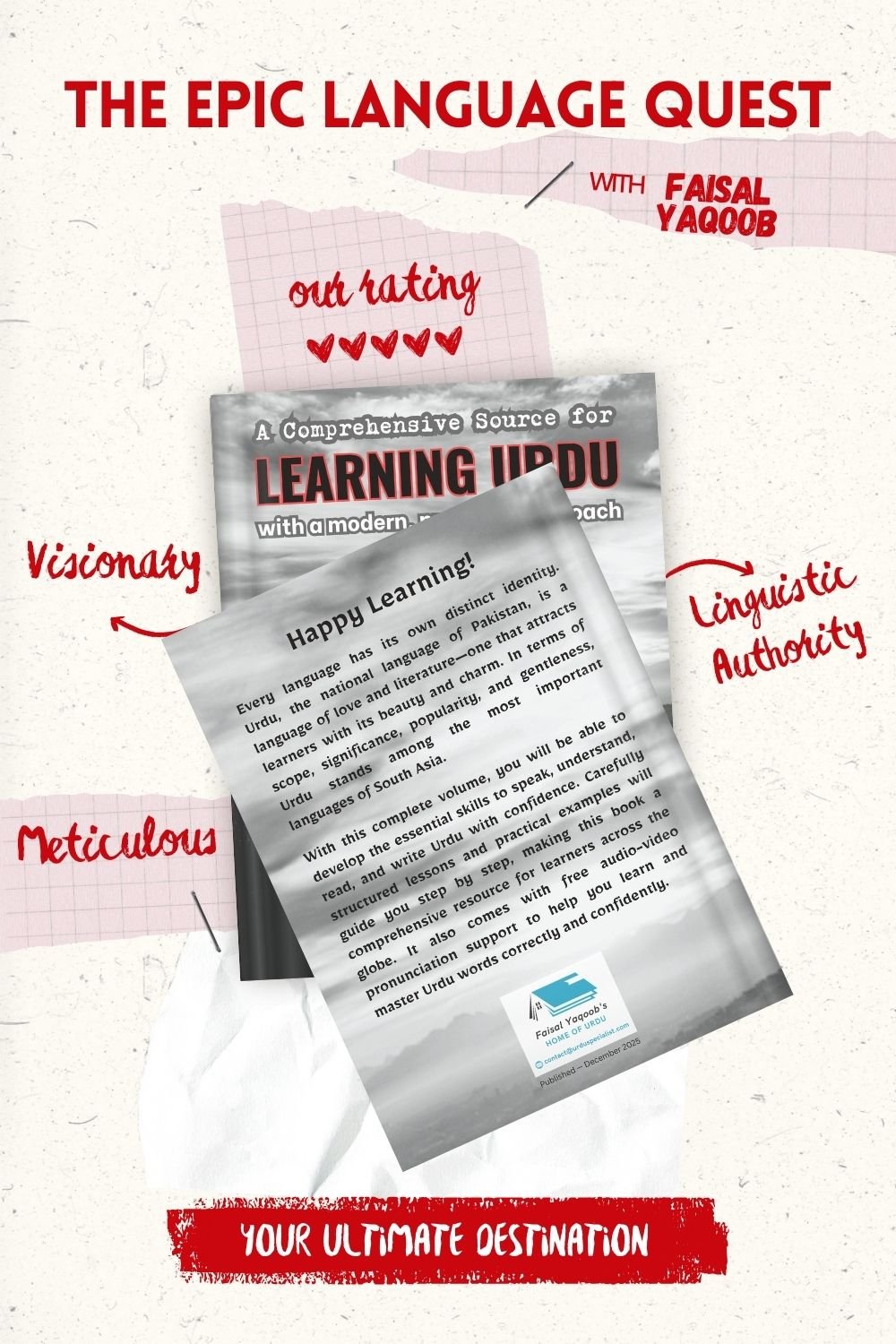
PREFACE: It is highly likely that no mission in the world is impossible for a human. A person’s destination is always reached through consistent effort and dedication. Humanity has advanced tremendously across the globe as a result of this trait. To me, learning a new language is an adventure, similar to sailing. While, floating on the vast ocean of linguistic heritage, among the rising and rolling waves of words; the voyage carries on the calm, and sometimes excited winds of notions.
This book earnestly endeavors to teach Urdu in a technically sound manner so that the learners wouldn’t have any fears about their lack of proficiency or inferiority complex and would steadily build competent and strong command of the language from the very beginning. The idea is to lay a solid foundation and acquaint them with the language and expressions as if it were their native tongue.
At the conclusion of Volume 1, two linguistically purposeful components have been added to strengthen the learner’s foundational skills. The first is a detailed section on numbers, presented in a clear and systematic way. This section helps learners confidently read, write, and say numbers in Urdu—from one all the way up to one trillion—building both fluency and accuracy in numerical expression. The second is a carefully selected list of over 800 English words that have become an established part of the Urdu language, now widely used and understood by Urdu speakers. Although the Urdu language contains thousands of such borrowed words, this collection focuses on the most frequently used and easily recognizable ones. By including these shared terms, the book makes vocabulary learning more accessible and shows how Urdu naturally blends with English in everyday use.
By this stage, the learner develops a natural connection with the language, gaining the ability to think and respond in Urdu with ease. But that’s just the beginning.
Volume 2 takes a major step forward. It is designed for learners who are now ready to deepen their understanding and use Urdu with greater accuracy, fluency, and expression. In this volume, we move beyond the basics into more advanced grammar, sentence structures, and expressive tools.
Some of the key topics covered in Volume 2 include:
• Infinitives and Gerunds, along with their various types and uses
• Derivational Nouns—how they are formed and their different categories
• Participle Adjectives, and how they add descriptive power to the language
• Nominalization, which turns actions into ideas or objects
• A full section on Adverbs and how time is expressed in Urdu
• A complete breakdown of Tenses—Past, Present, and Future—with over 20 types and variations in Active Voice
• The same tenses taught again in Passive Voice, helping learners gain full command of both forms
• The Imperative mood, Imminent actions, and the use of modal verbs like “should”
Here, I would like to mention an essential aspect of learning a language: pronunciation. You will find that almost every Urdu word in this book has its pronunciation given next to it. I have put in tremendous effort to make it systematic and standardized, yet simple, comprehensible, easy to learn, and above all, completely error-free. These pronunciations are closely aligned with a certified Urdu dictionary, down to the smallest detail. Let’s have a look at some of its unique features that are employed throughout this book.
To enhance your learning experience, I have recorded audio-video pronunciations for the Urdu words included in this book. The main access link to these files is provided on the Book Specifications page on our website. Learners can also view these files anytime via our YouTube channel, which is linked on the homepage of our website. These resources are carefully designed to help you understand and pronounce Urdu words clearly and confidently.
With the aid of my MA in Mass Communication and well over two decades of professional experience in the field of Urdu copywriting, translation, and interpretation, I have done my best through this book to help learners of all levels and backgrounds—including students following different curricula, non-native speakers, and immigrants—become proficient in Urdu while receiving clear, in-depth guidance. In addition, my ongoing work in offering linguistic support to students and professionals—particularly in improving orthography and pronunciation—has greatly shaped the approach I have adopted in this book. Since this book is for learners of all levels, I have used simple English throughout to ensure clarity and ease of understanding.
Have a blessed journey of Learning URDU with this comprehensive guide, now combining both Volume 1 and Volume 2!
